
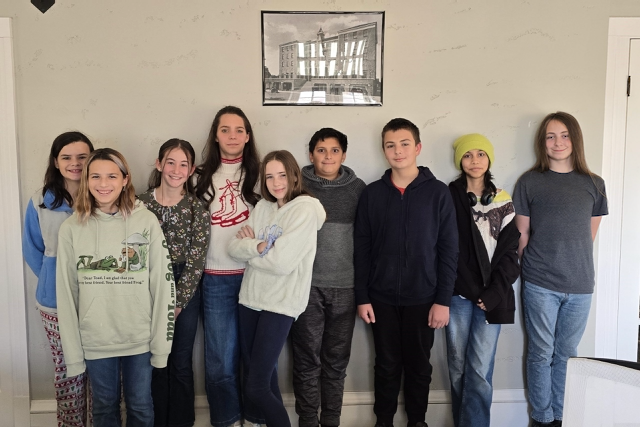
Students from School for Advanced Studies Northwest Arkansas joined more than 400 middle school students from across the state for a once-in-a-lifetime opportunity – participating a youth town hall with former President Barack Obama at the Crystal Bridges Museum of American Art in Bentonville. Hosted as part of the museum’s civic leadership series, the event invited students to explore what leadership, service, and community engagement mean to today’s young people.
After the event, students gathered for a seminar-style conversation on campus to reflect on what they saw, heard, and learned. Their insights offer a glimpse into how young Arkansans are thinking about leadership, purpose, and the future of their state.
Q: What did the room feel like just before President Obama walked in?
Students:
The energy was electric and quiet at the same time. Everyone kept glancing at the doors. Each time someone entered, hundreds of heads turned. When the moment finally came, the room went still, then everyone stood and clapped. It felt like a big build-up, then suddenly this very real moment was happening right in front of us.
Q: What stood out when you first arrived at Crystal Bridges?
Students:
The security. We have been to the museum before, but never with metal detectors and so many secret service agents. The museum itself was unusually calm and nearly empty, which made it feel important.
Q: When did it become real that you were about to see a former president?
Students:
Two things. First, the museum screens started showing fun facts about President Obama. Second, the room changed right before he came in. People got noticeably quiet and almost everyone was on their feet waiting. That was the moment.
Q: You wrote questions beforehand. What did you ask and why?
Students:
- How do you keep going when things get hard and it feels like everything is falling apart? We wanted to hear about perseverance.
- What did you do for your community when you were a kid in Hawaii? We were curious about service before politics.
- What advice did you wish someone had given you when you were our age? We wanted guidance that fits middle school life right now.
Q: What did you hear about purpose and pathways?
Students:
He said he did not grow up planning to be president. As a kid, he wanted to play basketball. In college he began to notice his own good fortune and felt pulled toward helping others. That shift toward service mattered more than a specific job title. We took away that you do not have to have it all figured out in middle school. Focus on the kind of person you are becoming and the community you are building.
Q: What did he say great leaders actually do?
Students:
Listen to people who think differently. He gave examples from disaster response and explained why you need teammates who see what you might miss. That made us think about choosing friends who help us make good decisions. If everyone thinks the same way, you keep missing the same things.
Q: Did anything surprise you about his tone or personal habits?
Students:
He was more casual and funnier than we expected. He also talked about family routines. When he was in Washington, he tried to be home for dinner with his wife and daughters each night. That grounded him and reminded him of who he was working for. He also brought students to the White House for science fairs, which showed us you can keep your curiosity and sense of fun even in serious roles.
Q: What issues feel most important to your generation right now?
Students:
- The internet shaping beliefs. Rumors can feel true just because everyone is sharing them.
- Social media bubbles and division. There used to be fewer channels and a more shared culture; now it is easy to get stuck in a tiny world.
- Climate and the environment. We talked about pollution, pesticides, and how our food systems affect health.
- Animal welfare and illegal hunting. We want to remember that we are guests in animal habitats.
Overall, we feel it is becoming too normal to live in unhealthy ways, online and offline, and we want to push back.
Q: What can middle school students do right now in their communities?
Students:
- Start small and be consistent. You might not change the whole world today, but you can absolutely change someone’s world.
Q: Did this change how you will pay attention to news or civic conversations?
Students:
Yes. Meeting him made us more likely to lean in when we see his name because now the ideas feel connected to a real person. Several of us said we will listen longer, ask better questions, and look for sources beyond the algorithm.
Q: Finish the sentence: “One thing I learned about leadership is…”
Students:
- You do not need to do what everyone else has done. Find your way.
- Stay humble and remember who you serve.
- Leadership is not bossing people around. It is guiding people toward the right path.
- Great leaders build great teams.
- You can lead with small actions that help a smaller community.
- Your goal should be to help, not to harm.
Q: Finish the sentence: “One thing I want adults to understand about kids my age is…”
Students:
- We are trying. Sometimes our best is not always an A.
- We do not always know exactly what we feel, and we are still learning how to say it.
- Using slang doesn’t mean we don’t know how to speak. It is also a language.
- It is okay if we see something differently than you do. That is part of growing up.
Q: Finish the sentence: “After this experience, I feel inspired to…”
Students:
- Help our community, starting with our school and classmates.
- Propose ideas and actually follow through on them.
- Give a voice to peers who haven’t found their voice yet.
- Look at problems from new angles and seek out different perspectives.
Why this matters for Arkansas and for our school
Our students’ reflections echo what we aim to do every day at School for Advanced Studies: to teach through deep inquiry, seminar-style discussion, and energetic civil discourse, guided by passionate teachers.
That is Arkansas education at its best: students learning to elevate their own lives by elevating others, right here at home. Inspired teachers and a seminar culture help make that possible every day.